
Misconceptions About Climate Finance Readiness
The misconception that readiness equates to proposal-writing can cost institutions time, credibility, and access to finance. When funders talk about readiness, they are really thinking about four core components:
- Data Systems: Reliable methods to collect, store, and process climate-related information.
- Monitoring Frameworks: Ability to track progress against clearly defined targets.
- Verification Capacity: Systems to ensure claims and outcomes are auditable and independently validated.
- Risk Visibility: Ability to identify, assess, and communicate the risks that might affect project outcomes.
Take the example of the Green Climate Fund (GCF). In several of their readiness programmes, grantees must demonstrate that they have functional data systems before funds are even disbursed. Simply submitting a project concept is insufficient; the institution must show that it can track carbon reductions, climate resilience indicators, or biodiversity outcomes consistently over time. Similarly, in the Adaptation Fund, readiness grants are frequently used to strengthen the monitoring, reporting, and verification (MRV) frameworks of local institutions. Without these systems in place, even technically sound projects struggle to access climate finance because funders cannot validate impact.
What True Readiness Looks Like
i. Tracking Impact Over Time
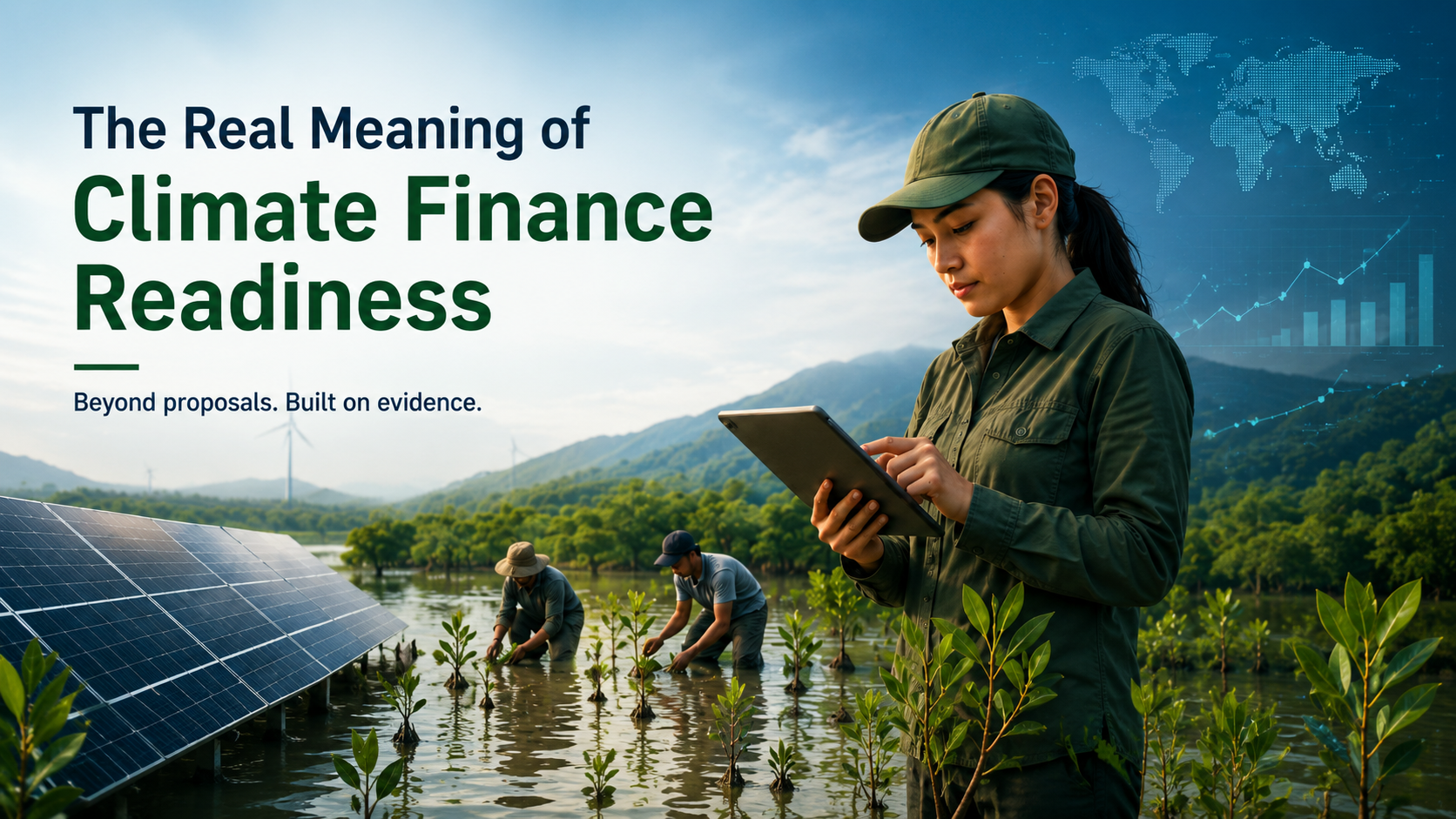
Organisations must be able to track impact over time. A project may plant 10,000 mangroves in a coastal community, but readiness is demonstrated when the institution can show how many trees survive over three years, how they improve shoreline stability, and how they contribute to carbon sequestration. In Indonesia, a community-led mangrove restoration initiative partnered with a local NGO and a carbon registry to monitor survival rates and carbon capture. This level of tracking allowed the community to access additional climate finance from carbon markets because they could prove actual outcomes, not just intentions.
ii. Proving Outcomes
Readiness also requires the capacity to prove outcomes. Funders are interested in results, not just activities. Consider a renewable energy program in Kenya: a local cooperative installed solar panels in 500 households. Readiness meant that the cooperative could track energy savings, improvements in local livelihoods, and reductions in kerosene usage. With this verified data, the cooperative successfully applied for blended finance from a combination of private and public sources. Without the ability to demonstrate measurable results, funders would have been reluctant to invest, regardless of the technical merits of the project.
iii Reducing Uncertainty
Finally, readiness involves the ability to reduce uncertainty. Climate finance often comes with significant risk, including fluctuating weather patterns, market volatility, and socio-political instability. Organizations that can anticipate, measure, and mitigate these risks are far more attractive to funders. A flood-resilience project in Bangladesh, for example, implemented early-warning systems and real-time flood monitoring. This risk visibility not only improved project design but also increased investor confidence, resulting in faster and larger funding disbursements. In essence, readiness is about demonstrating that projects are not only well-designed but also resilient and adaptive to changing conditions.
iv Readiness as Evidence Infrastructure
The key insight is that climate finance readiness is evidence infrastructure, not a stack of forms. It is about building systems capable of capturing, validating, and communicating outcomes over time. Think of it like a high-performance sports team: having the best players (projects) is important, but without analytics, performance tracking, and training regimes (systems), success is inconsistent.
Forward-looking institutions invest in strengthening their internal capacities and evidence management systems, rather than focusing solely on proposals. These systems include data pipelines, monitoring frameworks, verification protocols, and risk dashboards—all designed to demonstrate that interventions are effective and sustainable.
Practical Examples of Climate Finance Readiness
Numerous real-world examples illustrate the power of treating readiness as infrastructure rather than paperwork.
- Forest Carbon Projects (Latin America): Satellite monitoring and community-based reporting enabled NGOs to secure multi-year carbon finance agreements, demonstrating verified results.
- Climate-Smart Agriculture (Uganda): Farmers’ cooperatives used soil moisture sensors, mobile reporting apps, and feedback loops to quantify yield improvements and resilience outcomes, unlocking blended finance from both development banks and private investors.
- Urban Flood Mitigation (Southeast Asia): Municipal authorities implemented risk modeling and real-time monitoring systems. By demonstrating the ability to anticipate and respond to flood events, they attracted climate adaptation funds that might have otherwise gone to better-prepared cities.
How Organizations Can Build Readiness
For organizations aiming to improve climate finance readiness, several practical steps can make a significant difference:
- Invest in Digital Data Systems: Cloud platforms, mobile surveys, and IoT sensors strengthen the collection and storage of climate data.
- Design Robust Monitoring & Evaluation Frameworks: Define indicators, baselines, and targets, and use dashboards to visualize progress over time.
- Strengthen Verification Mechanisms: Ensure third-party or independent validation is possible, with documentation that meets funder requirements.
- Map and Manage Risks: Identify operational, environmental, and financial risks, while developing mitigation strategies and early-warning systems.
The Takeaway
Climate finance readiness is not a matter of submitting the perfect proposal. It is about building systems that generate credible, auditable evidence. Organizations that approach readiness as data and verification infrastructure position themselves to unlock substantial finance, scale impact, and build trust with funders.
Proposals may open the door, but systems win the room. Funders invest in verified outcomes, not intentions, and organizations that can demonstrate their impact while managing risks effectively are far more likely to succeed in securing climate finance.
In today’s competitive climate finance landscape, readiness is the new frontier—moving beyond ideas on paper to evidence-backed impact that inspires confidence, attracts investment, and accelerates climate solutions.
Need support developing a climate finance proposal, donor strategy, or MEAL framework? Contact Agenda Beyond Borders for advisory support.
Author
Simon Okola
PhD Candidate in Project Financing | Climate Finance & MEAL Consultant | Helping NGOs, MFIs, SACCOs & Counties Become Climate-Finance Ready