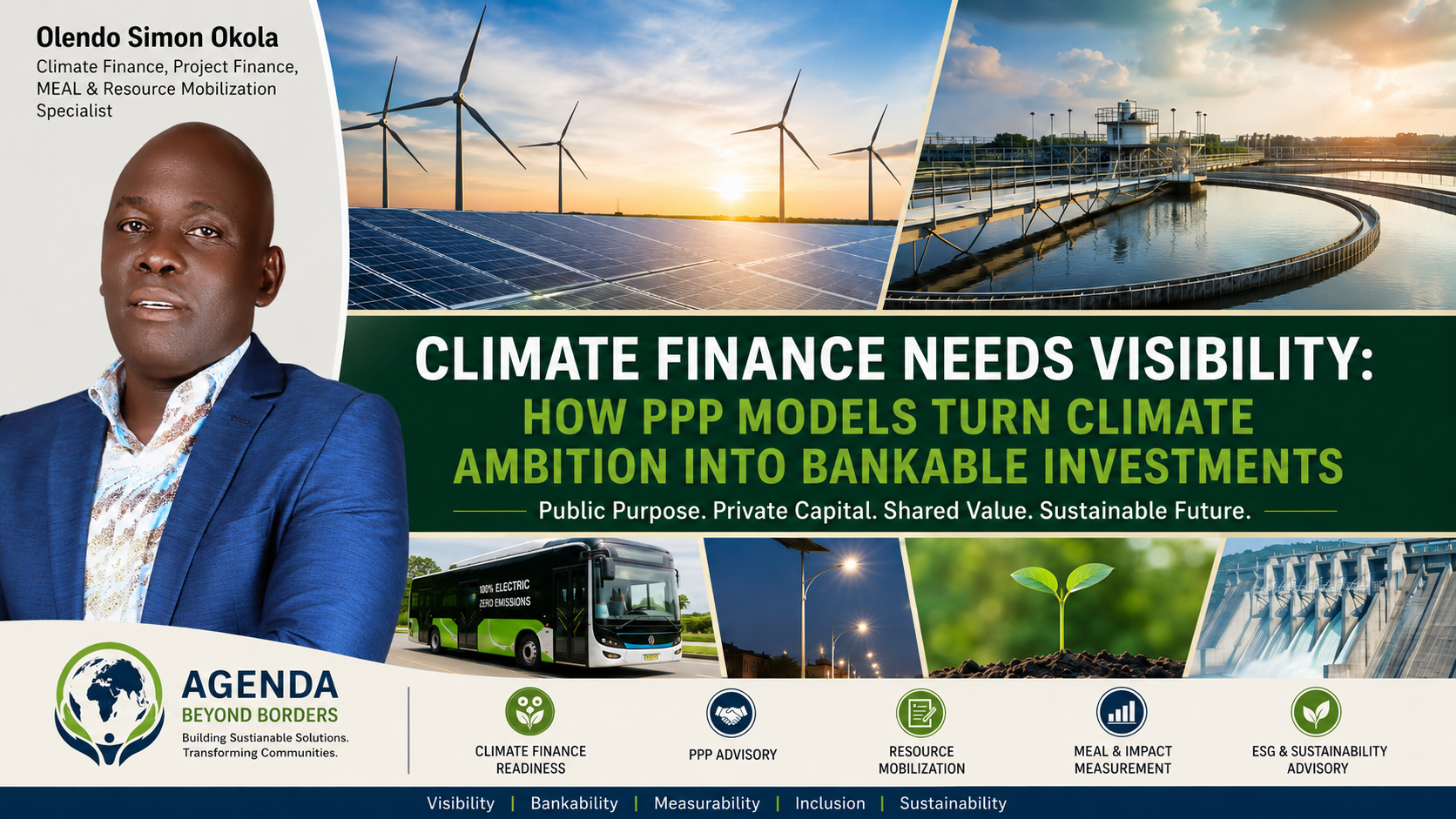

Africa does not only face a climate finance gap. It faces a climate finance readiness gap.
Across the continent, governments, counties, NGOs, CBOs, private sector actors and development institutions are developing climate strategies, adaptation plans and project ideas. Yet many still struggle to attract serious climate finance because climate ambition alone is not enough. Funders, development finance institutions, carbon buyers and investors increasingly want evidence, credible systems, bankable pipelines and measurable results.
This is the central message of Agenda Beyond Borders’ technical paper, From Compliance to Capital: Africa must move beyond simply complying with climate reporting requirements and begin building the institutional systems that convert climate action into financeable investment opportunities.
Under the Paris Agreement and Article 6 carbon market framework, climate finance is becoming more technical, competitive and evidence-driven. Countries and institutions that can demonstrate strong monitoring, reporting and verification systems, investor-usable data, clear project pipelines and credible governance structures will be better positioned to access capital.
In simple terms, climate finance is no longer only about need. It is also about readiness.
Why Compliance Is No Longer Enough
Many African institutions already understand donor compliance. They prepare reports, attend climate meetings, submit project concepts and align their work with national priorities. But compliance does not automatically unlock finance.
Investors and climate funds ask deeper questions:
Can the project prove its climate impact?
Is there a credible monitoring and verification system?
Are the financial assumptions realistic?
Is there a clear implementation structure?
Can carbon revenues, green bonds or blended finance be used?
Are gender, safeguards and community benefits properly addressed?
Is the project ready for due diligence?
These questions determine whether a climate idea remains a concept note or becomes a fundable project.
The Missing Link: Investor-Usable Transparency
One of the biggest gaps in African climate finance is not lack of ideas. It is lack of usable, trusted and well-packaged information.
Investor-usable transparency means climate data, finance data, project evidence and impact information that can actually support investment decisions. This includes baseline data, MRV systems, risk analysis, financial models, safeguards, governance arrangements and clear reporting structures.
For NGOs, counties and development actors, this means that every climate project should be designed with finance in mind from the beginning. A tree-planting project, clean cooking initiative, climate-smart agriculture programme or youth green enterprise project must show not only what it intends to do, but how results will be measured, verified, financed and scaled.
Article 6 and the New Climate Finance Opportunity
Article 6 of the Paris Agreement creates opportunities for countries and projects to generate carbon-related finance through internationally transferred mitigation outcomes and carbon crediting mechanisms. But this opportunity will only benefit institutions that understand the rules and prepare early.
For a carbon project to attract buyers or investors, it must have credible authorization, strong MRV, clear ownership of carbon rights, safeguards, benefit-sharing arrangements and reliable verification. Without these systems, carbon revenue remains uncertain and cannot be treated as bankable income.
This is why African institutions must stop treating carbon markets as a shortcut. Carbon finance is an opportunity, but only for projects that are technically sound, legally clear and financially structured.
From Climate Projects to Bankable Pipelines
Africa needs more than scattered project ideas. It needs bankable climate project pipelines.
A bankable pipeline includes projects that have gone through proper preparation: feasibility assessment, stakeholder engagement, financial structuring, climate rationale, gender analysis, risk assessment, MRV design and funding alignment.
This is where blended finance, green bonds, climate funds, carbon markets and development finance can work together. A strong project pipeline can attract grants for readiness, concessional finance for early-stage development, guarantees to reduce risk and private capital for scaling.
The future belongs to institutions that can connect climate ambition with project finance discipline.
What This Means for Counties, NGOs and Development Partners
For county governments, the priority is to develop climate investment plans that go beyond policy documents and identify practical, finance-ready projects.
For NGOs and CBOs, the priority is to strengthen proposal quality, MRV systems, donor mapping and evidence-based project design.
For private sector actors, the opportunity lies in climate-smart business models, ESG readiness, carbon project development and green investment opportunities.
For development partners, the challenge is to support not only individual projects but the systems that make projects fundable and scalable.
The ABB Position
At Agenda Beyond Borders, we believe Africa’s climate finance future will be shaped by institutions that can combine technical knowledge, project finance, MRV, proposal development, ESG, carbon markets and partnership building.
Our work supports organizations to move from ideas to investment-ready climate solutions.
Consultancy Call-to-Action
Is your organization planning to develop a climate finance proposal, carbon project, ESG strategy, Article 6 concept, green investment pipeline or donor-ready project document?
Agenda Beyond Borders can support you with:
Climate finance readiness assessments
Donor mapping and funding opportunity scans
Concept note and full proposal development
MRV and results framework design
Carbon market and Article 6 project positioning
Green project pipeline development
ESG and sustainability advisory
Training for NGOs, counties, CBOs and institutions
Partner with Agenda Beyond Borders to turn climate ambition into bankable, measurable and fundable projects.
Contact: simonokola@agendabeyondborders.org
Website: www.agendabeyondborders.org