Climate finance has become one of the most important development conversations of our time. Across global summits, national policy spaces, donor platforms, investment forums and development programmes, the message is clear: the world must mobilise more finance to help vulnerable countries adapt to climate change, reduce emissions, protect livelihoods and build resilient economies. The numbers are large. The commitments are ambitious. The policy language is powerful. But for many communities in Africa, one question remains unanswered:
When will climate finance become visible in people’s daily lives?
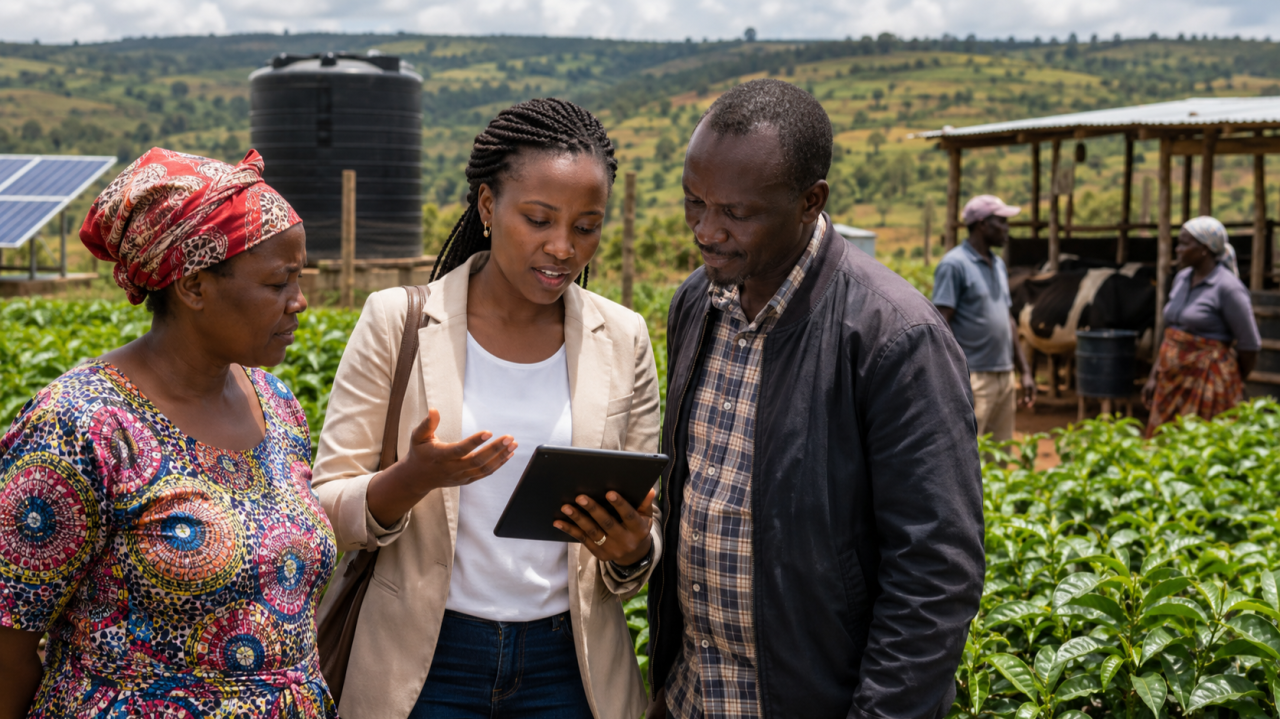
For a smallholder farmer in Meru, climate finance is not meaningful simply because billions of dollars have been pledged at a global summit. It becomes meaningful when that farmer can access affordable credit for water harvesting, improved dairy breeds, fodder production, soil conservation, solar-powered irrigation, climate advisory services, or crop and livestock insurance. It becomes meaningful when a coffee farmer can protect production from erratic rainfall, when a dairy farmer can maintain milk supply during dry seasons, and when a tea farmer can invest in practices that protect both productivity and the environment.
For a microfinance institution serving rural clients, climate finance is not meaningful because it appears in international reports. It becomes meaningful when the institution can design green loan products, train credit officers to understand climate risk, protect its loan portfolio from climate-related defaults, and support farmers whose income is directly affected by droughts, floods, pests, diseases and market disruptions.
For county governments, NGOs, SACCOs, cooperatives and community-based organisations, climate finance is not meaningful because it exists somewhere in global funds. It becomes meaningful when they can design bankable projects, access the right financing windows, implement with integrity, and prove that lives and livelihoods have improved. This is why climate finance must now move from global promises to local proof.
The problem is not only the size of climate finance
There is no doubt that the climate finance gap remains huge. Developing countries require far more finance than is currently flowing to them, especially for adaptation. UNEP’s 2025 Adaptation Gap Report estimates that developing countries will need around US$310–365 billion annually by 2035 for adaptation, while international public adaptation finance was about US$26 billion in 2023. This shows a major gap between what is needed and what is currently reaching countries most exposed to climate impacts.
The COP29 climate finance outcome also confirmed the scale of the challenge. Parties agreed on a goal for developed countries to mobilise at least US$300 billion annually by 2035, within a wider call to scale finance to at least US$1.3 trillion annually from all sources. These global figures matter. They show ambition, responsibility and the scale of investment needed. But the climate finance challenge is not only about the amount of money available. It is also about readiness.
Many local institutions are not yet adequately prepared to access, manage, absorb and report on climate finance. Some lack bankable project pipelines. Others lack strong monitoring and reporting systems. Some have good community ideas but weak investment cases. Others have donor relationships but limited climate-risk analysis. Some understand development work, but have not yet integrated climate finance logic into planning, budgeting, lending or reporting systems.This creates a major gap between global finance and local implementation.
A county government may have strong climate priorities such as water security, climate-smart agriculture, renewable energy or waste management, but without investable project documents, feasibility evidence, costed implementation plans and credible monitoring systems, those priorities may never attract serious finance. An NGO may have strong community relationships, but without climate rationale, gender-responsive indicators, value-for-money analysis and evidence of scalability, its proposal may fail to compete. A SACCO may serve thousands of farmers, but without green lending policies or climate-risk screening tools, it may unknowingly continue financing climate-vulnerable activities. The next frontier of climate finance is therefore not just mobilisation. It is practical readiness.
Climate risk is now financial risk
One of the most important shifts that institutions must understand is that climate risk is now financial risk. A drought is not only an environmental event. It can reduce crop yields, affect livestock productivity, weaken household income, increase loan default, reduce savings, disrupt value chains and increase food prices. A dairy farmer who loses pasture and water access may reduce milk production, struggle to repay a loan, and eventually become a higher-risk client for a lender. A coffee farmer affected by erratic rainfall may produce lower-quality yields, earn less income, and delay repayment. A trader whose supply chain depends on agricultural production may also be indirectly affected.
Flooding is not only a disaster management issue. It can destroy assets, damage roads, interrupt trade, displace households, increase disease burden and affect business continuity. In counties that experience repeated flooding, businesses may lose stock, households may lose productive assets, and financial institutions may face increased repayment stress among affected clients.
Heat stress is not only a weather concern. It can affect dairy productivity, labour performance, water availability and agricultural output. For rural economies that depend on agriculture, these climate effects eventually become financial effects.
For banks, SACCOs, microfinance institutions and agricultural lenders, these risks eventually appear in the balance sheet. They show up as non-performing loans, reduced repayment capacity, weakened collateral value, increased insurance claims and higher operational risks.
This is why green banking and climate-smart lending are no longer optional. They are part of responsible financial management. In Kenya, this conversation has become even more relevant. In April 2025, the Central Bank of Kenya released the Kenya Green Finance Taxonomy and the Climate Risk Disclosure Framework for the banking sector, giving financial institutions a clearer basis for identifying green finance activities and strengthening climate-risk disclosure. This is a strong signal that climate risk is moving from a corporate social responsibility issue to a core financial governance issue. Financial institutions that understand climate risk early will be better positioned to protect their clients, strengthen their portfolios, attract green capital and remain competitive in a changing financial environment. Local financial institutions are climate finance actors
One of the biggest opportunities in Africa lies in working with local financial institutions. Microfinance institutions, SACCOs, cooperative banks and rural lenders are often closest to the people most affected by climate change. They know the farmers, traders, producer groups, women’s groups, youth enterprises and informal businesses that larger financial actors may not easily reach. These institutions can become powerful climate finance delivery channels if they are properly supported. Consider a microfinance institution working with dairy farmers in Meru County. The institution may already be financing cows, feed, farm inputs or small businesses. But with a climate-smart financing approach, it can go further. It can finance water storage tanks, climate-resilient fodder production, biogas systems, improved cowsheds, milk coolers, solar lighting, veterinary support and climate advisory services. These investments would not only improve the farmer’s resilience; they would also protect the lender’s portfolio by reducing climate-related repayment risks.
The same applies to tea and coffee value chains. A lender serving tea farmers can support soil conservation, water harvesting, tree planting, renewable energy for processing, and climate-smart farm management. A SACCO working with coffee farmers can finance shade trees, organic soil improvement, efficient water use and value addition. These are not abstract climate actions. They are practical investments that link climate resilience with income stability. This is where climate finance becomes practical. Not as a distant policy concept, but as a real financial product in the hands of a farmer, entrepreneur, cooperative or household.
Climate-smart agricultural finance is a major opportunity
Agriculture remains central to Africa’s economy and livelihoods. Yet it is also one of the most climate-exposed sectors. This makes climate-smart agricultural finance one of the most important growth areas for development partners, financial institutions and governments.
Climate-smart agricultural finance is not simply giving loans to farmers. It is the design of financial products that help farmers and agricultural value-chain actors increase productivity, adapt to climate change, reduce avoidable losses and build long-term resilience.
For example, a loan for solar-powered irrigation can help a farmer reduce dependence on unreliable rainfall. A loan for a milk cooler can help a dairy cooperative reduce post-harvest losses. A loan for climate-resilient fodder production can help farmers maintain milk production during dry periods. A loan for clean energy can reduce operating costs for rural enterprises. A loan linked to crop insurance can protect both the farmer and the lender when climate shocks occur. For financial institutions, this creates both impact and business value.
Climate-smart products can help reduce default risk, attract concessional funds, expand the client base, strengthen loyalty, and position the institution as a serious green finance actor. But this requires a shift in mindset. Credit officers must be trained to understand climate risk. Loan appraisal systems must include climate considerations. Product design must reflect seasonal realities. Repayment models must be adapted to agricultural cycles. Institutions must collect data not only on repayment, but also on resilience outcomes.
A credit officer visiting a farm should not only ask, “Can this client repay?” They should also ask, “What climate risks could affect this client’s repayment ability, and what investment can reduce that risk?” That is the foundation of climate-smart agricultural finance.
Evidence will define the future of climate finance
One of the weakest areas in many climate finance projects is evidence. Too many projects still report activities instead of outcomes. They count the number of people trained, trees planted, loans issued or technologies distributed. These are useful numbers, but they are not enough. Climate finance must go further.
If a project finances water harvesting tanks, it should show whether households had more reliable water during dry periods. If a project supports agroforestry, it should track tree survival, soil improvement, farm productivity and income effects. If a financial institution offers green loans, it should monitor not only the number of loans issued, but also whether the financed investments improved resilience, reduced losses or supported income stability.
If a dairy farmer receives finance for improved fodder production, the important question is not only whether the loan was disbursed. The real question is whether milk production remained stable during climate stress, whether income improved, whether repayment was protected, and whether the household became less vulnerable.
This is why Monitoring, Reporting and Evaluation must sit at the centre of climate finance. Strong MRV systems help institutions prove impact, attract investors, satisfy donors, improve accountability and learn what works. Without credible data, climate finance becomes a story of good intentions. With credible evidence, it becomes a foundation for scale.
Africa needs investable climate pipelines
Another major gap is the shortage of investable climate projects. Many institutions have good ideas, but not enough structured projects. A strong climate finance project must clearly define the problem, climate rationale, target beneficiaries, financing model, risk profile, implementation arrangement, expected outcomes, sustainability plan and measurement framework.
For example, a county may want to support climate-smart agriculture, but an investor or donor will need more than a general statement. They will need to understand the specific climate risk being addressed, the target value chain, the proposed financing model, the role of farmers and cooperatives, the cost structure, the expected adaptation benefits, the gender and youth inclusion strategy, the repayment or sustainability pathway, and the evidence system. This is where many NGOs, counties and local institutions need support.
They do not only need proposal writing. They need climate finance readiness. They need project preparation. They need business models. They need blended finance thinking. They need gender-responsive design. They need bankability analysis. They need data systems. They need the ability to speak both the language of communities and the language of investors. That combination is where the next generation of climate finance leadership will emerge.
The way forward
Climate finance must become more practical, people-centred, accountable and locally relevant. It must move from pledges to pipelines. From policy language to financial products. From activities to measurable resilience. From donor dependency to blended finance. From isolated projects to scalable systems. From global commitments to local proof. Africa does not only need more climate finance. Africa needs climate finance that reaches the right people, through the right institutions, with the right products, backed by the right evidence.
The institutions that will lead this next phase will be those that can build strong systems, design investable projects, manage climate risk, report credible results and demonstrate real community impact. At Agenda Beyond Borders, this is the space we are committed to strengthening: practical climate finance readiness, green lending, climate-smart agricultural finance, MRV, project design and evidence-based resilience programming.
If you are an NGO, county government, microfinance institution, SACCO, donor programme or development partner, the question is no longer whether climate finance matters.
The real question is: Are your systems ready to access, manage and prove the impact of climate finance?
Author
Simon Okola
PhD Candidate in Project Financing | Climate Finance & MEAL Consultant | Helping NGOs, MFIs, SACCOs & Counties Become Climate-Finance Ready